Friday, 24 April 2015

Hollow fiber nanofiltration

Patent filing no.: 742/KOL/2014

Technology title: Novel hollow fiber nanofiltration membrane using ZnCl2 incorporated polysulfone Polysulfone (PSF)/Polyethyleneglycol (PEG) blend

  1. Brief description
            In this work, organic (polyethylene glycol, PEG-200)  as  well  as inorganic  (ZnCl2)  are simultaneously used as additives  (both  are  well  known  pore  constrictors) to polysulfone (PSF)/ dimethyl formamide (DMF) system  in order  to get hollow fiber NF membrane. Synergistic effects of pore constriction by zinc chloride and polyethylene glycol (PEG) are exploited to get nanofiltration grade fibers. The composition of the membrane was 16 to 18 wt% PSF, 2 wt% PEG-200, ZnCl2 1 to 2 wt% and rest dimethyl formamide (DMF). The molecular weight cut off of this membrane was 250 to 900 Da. This membrane is used for rejection of multivalent salts and organic dye. 30 to 45 % NaCl salt are rejected through this membrane at pH 2 to 11 range. 55 to 60% Na2SO4 salt are rejected at pH 11 through this membrane.   

  1. Commercial aspects of the technology & Industries benefiting from it
            Commercial NF hollow fiber membrane is prepared using a spinneret which is costly. Therefore, the commercial hollow fiber cartridges are expensive. In this invention, nanofiltration hollow fibers were spun using an indigenously designed low cost process. Synergistic effects of pore constriction by zinc chloride i.e. inorganic additive and polyethylene glycol (PEG) i.e. organic additive are exploited to get nanofiltration grade fibers.

Some applications of hollow fiber NF are listed below. 
 (i) Removal of dyes (or colored component) from water by physical separation without any chemical treatment.
(ii) Concentration of fruit juices without any thermal treatment.
(iii) Removal of humic acid, bacteria and other pathogenic organisms from waste water.
 (iv) Textile industry effluent water treatment (reduction in COD content) without any chemical treatment.
(v) Desalination of salt water.
(vi) Removal of heavy metals from industrial pollutant.

  1. Advantages of this technology
·         Unique formulation of membrane to obtain NF hollow fiber in one step.
·         No additional step for surface modification.
·         Solutes with molecular weight 250 to 900 are completely removed from solution.

  1. Summary of the technical details
            Polymer (PSF) was heated to 70 to 80oC for 2-3 h so that the moisture in the polymer was evaporated. Fixed amount (2%) of PEG (molecular weight 200 Da) and ZnCl2 1.0 to 2.0 % was added to a premixed 16 to 18% PSF in DMF dissolved at 60 to 80°C. The polymer was dissolved in DMF and the mixture was kept for 6 to 8 hours at 60 to 80oC temperature under mild stirring. This solution was used for spinning the hollow fibers.


5.    Future prospects of the technology:
Uses as waste water treatment in textile and pharmaceutical industries, desalination. The technology is off the shelf and can easily be scaled up for industrial purposes.


Tuesday, 21 April 2015

Technology for removal of humic acid

Patent filing no.: 1058/KOL/2014

Technology title: Chitosan coated iron-oxide- polyacrylonitrile mixed matrix membrane for removal of humic acid


  1. Brief description of the technology
            The proposed invention relates to the fabrication of mixed matrix membrane (MMM) using iron oxide nanoparticles and polyacrylonitrile (PAN) coated with chitosan which is used for removal of humic acid from surface water. Typical humic acid concentration in surface water is up to 50 mg/l whereas in drinking water EPA imposed limit is 2 mg/l. The composition of the membrane was 15 wt% PAN, 0.4 wt% iron oxide and rest was solvent dimethylformamide (DMF). The molecular weight cut off of this membrane was 44 kDa. The membrane was tested at different concentration of synthetic humic acid as well as pond water. The range of operating conditions for was 276 kPa to 550 kPa and 40 to 80 l/h cross flow rate. The filtered water produced was in the range of 15 to 25 l/m2h and total humic acid concentration in filtrate reached below permissible limit i.e., 2 mg/l. The process does not need addition of external additives or catalysts and process throughput is high.

  1. Commercial aspects of the technology & industries benefiting from it:
1.     Waste water treatment plant, as an annexure to the main operating section of various plants.
2.     Scaled-up filter for domestic and industrial use.

      3.   Advantages

·         Unique formulation of membrane removes humic acid.
·         Concentration of humic acid in the treated water was reduced below 2 mg/l (EPA limit).
·         Iron oxide nanoparticles are inexpensive thereby, reducing the operating cost.
·         Any post processing step is not required.
·         Selective adsorption of humic acid, microorganisms and filtration of larger particles are attained in a single step.

       4.  A summary of the technical details involved

1.     Composition of base mixed matrix membrane:
a)     15 wt% coated polyacrylonitrile (PAN);
b)    iron oxide in an amount ranging from 0.4 wt%; and
c)     solvent dimethyl formamide (DMF) in an amount ranging from 84.6  wt%.

2.     Composition of chitosan coating:
a)     1 to 5 wt% chitosan in 1 to 6 vol% acetic acid;
b)    Glutaraldehyde in an amount of 0.1%;
c)     NaOH in an amount ranging from 0.5 to 1 N.

        5. Future prospects of the technology

 1.     Possible use in waste water treatment plant.
 2.     Development of scaled-up filter for domestic and industrial use.

Inventors: Prof. Sirshendu De, Ms. Swapna Rekha Panda, Ms. Munmun Mukherjee


Tuesday, 14 April 2015

High performance electrodes for Li-ion battery

Patent filing number: 613/KOL/2014

Technology title: Porous nanostructured tin-animony-copper intermetallic electrodes as anode material for lithium ion batteries

1.    A brief description of the technology
The technology is capable of fabricating Tin-Antimony- Copper based open-pore three dimensional nanostructure anodes for lithium ion batteries, which display high discharge capacity as well as good cyclability. The fabrication was carried out through electrodeposition route and devoid of any post-plating treatment except vacuum drying. The developed anode did not contain any binder or additive which take up lithium and add to capacity.

2.    Commercial aspects of the technology & Industries benefiting from it
Electronics industries are heavily dependent on high capacity batteries.Various automobile companies are looking forward to launch electric vehicles to conserve fossil fuels. However they are stuck with performance of the battery especially the specific capacity. This technology has come up with a cheap fabrication process to increase battery capacity and will definitely be in the eye of those companies.This methodology can also be implemented to design and fabricate power sources for MEMS devices which are currently finding its use in diverse fields like biomedical instrumentation.

3.    Advantages of this technology over the already existing methods
Currently, most commercial lithium - ion batteries use graphite as the anodic material and lithium mixed oxide (e.g. LiCoO2) as the cathodic material. Graphite, though readily available at an economical price, has a low theoretical gravimetric capacity (372mAh/g). This, in turn, reduces the overall discharge capacity of the battery. Recently, tin has emerged as one of the novel materials which have the potential to replace carbonaceous anode materials as it has a very high theoretical capacity (993 mAh/g). It however suffers from the drawback of a very high volume change during the lithiation/delithiation process (about 300%). This high volumetric expansion can lead to the gradual detachment of the anodic material from the current collector as well as its pulverization which ultimately results in a poor cyclability performance of the battery.
Various efforts have been made in this direction to overcome this particular shortcoming of tin based anodes. Alloying or forming mixtures with other active metals, notably antimony, is one of the most tried methods. While antimony is an active element, it reacts with lithium at a potential different from tin and hence buffers the expansion of the latter when it reacts with lithium.

4.    A summary of the technical details involved.
This method uses an aqueous solution of inorganic salts of tin, antimony and copper and does not consist of any kind of surfactant or detergent. Deposition was done at very high overvoltage to facilitate hydrogen evolution in order to obtain a porous structure. The anode material shows a consistent capacity over 1100mAh. This is possible because of the presence of intermetallics in the material and open-pore morphology.

          5.    Future prospects of the technology.

To further increase the electronic conductivity of the anode and hence improve the rate capability, we plan to incorporate carbon nanotubes or graphene into our alloy system. This methodology is expected to show a drastic increase in the power density of the anode. We further plan to use this system as the anode for a battery along with the cathode which has been developed by our collaborators and improve on the results which we will obtain.

Inventors: Prof. Siddhartha Das, Prof. Karabi Das, Mr. Abhinav Kumar, Mr. Srijan Sengupta, Mr. Arijit Mitra

Tuesday, 7 April 2015

Food technology to tackle severe acute malnutrition

Patent Filing No. 748/KOL/2014

Media Coverage: Business Standard Link, NDTV Link

1.    A brief description of the technology.
High energy and nutrient rich food paste as per WHO and UNICEF specifications is a “Medical Nutrition Therapy” based on sound scientific principles with a balanced composition of nutrients for the recovery of SAM children. Apart from anthropometric recovery, energy dense food paste results in physiological and functional (including immunological) recovery to tackle severe acute malnutrition (SAM). Five ready to eat (RTE) energy dense food paste recipes are formulated using the Linear Programming in MATLAB. Protein, fat, energy value, moisture content etc. as specified by the UNICEF/WHO standards are maintained as constraints. The prepared formulations were validated. Vitamin & Mineral premix is designed and formulated meeting the requirements as specified by the UNICEF. The developed high energy nutrient rich food pastes are easy digestible, palatable soft and crushable which require no additional method of preparation and can be consumed directly from the pouch / tube. These food pastes require no refrigeration and can be stored at room temperatures. The food paste has low water activity and is shelf stable.

2.     Commercial aspects of the technology & Industries benefiting from it.
The process technology for development of high energy nutrient rich food paste in ready to eat form is entirely new for the Indian market. The high energy nutrient rich food paste that are developed as a part of the project funded by (i) Department of Biotechnology, Government of India and (ii) M/s Gattappu Chemicals Private Limited, New Delhi. The products developed are to be scaled up to pilot scale production after which will be taken up by the industry for clinical trials and subsequent commercial production. A Pilot-Scale unit with a production capacity of 100kg/day is being set up at IIT Kharagpur. The objective of this product is to tackle cases of Severe Acute Malnutrition. The end users of this product are
·         Severe Acute Malnourished Children
·         Children with AIDS who is suffering from wasting
·         AIDS patients with nutritional deficiency
Accordingly suitable NGO’s, other food nutrition and food safety sectors can play a major partner role in taking the product to the required target group. The technology has been transferred to M/S Gattapu Chemical Pvt. Ltd., New Delhi.

3.     Advantages of this technology over the already existing methods.
The main purpose of this ready to eat food paste is to serve the essential nutrients and energy for the severely acute malnourished and favor growth and development.
·         The developed high energy nutrient rich food pastes are easy digestible, palatable soft and crushable which require no additional method of preparation and can be consumed directly from the pouch/tube.
·         This food paste requires no refrigeration and can be stored at room temperatures.
·         The food paste has a low water activity and is shelf stable.
·         The high energy nutrient rich food paste is mainly targeted to eradicate severe acute malnutrition at community level.
·         By shortening the duration of inpatient treatment from an average of 30 days to only 5-10 days, the move towards using food paste in the recovery phase of treatment reduces the resources needed to treat SAM, which improves cost-effectiveness.

4.     A summary of the technical details involved.
High energy and nutrient rich food pastes are made using local ingredients and indigenously developed process technology. Three recipes are made out of peanut and one from potato and one from Bengal gram. The formulations contain other energy rich ingredients like sugar, glucose, skimmed milk powder, soy protein isolate, mineral vitamin mix etc. These ingredients increases the nutritive and sensory value of the final product which are be liked by children community fulfilling the demand of suitable food for SAM children.
 The processing comprises of steps like roasting, grinding, mixing and colloidal milling. The vitamin and mineral premix designed uniquely for these formulations with proper deliverability and stability. The production of the RTE food paste includes various processes like roasting, grinding, mixing, and milling. The process parameter like mixing time and mixing speed are optimized for the mixing of the ingredients in a planetary mixer. Additives like stabilizer and emulsifier required to maintain the stability of the product are also optimized. After mixing the product is passed through colloidal mill to get a fine paste of smooth consistency. The product is then packed in flexible pouches/tubes and stored.

5.     Future prospects of the technology.

Formulations with the alteration of ingredients can be made possible and changes could be made to the technology developed. Further the technology can be used to develop products to deal with various stages of malnutrition. This technology will be an efficient tool to deal with food security aspects in the future. 


Monday, 30 March 2015

Heart and Lung Sound Analyzer

Heart Sound Analyzer (primary patent 85/KOL/2008 )
Inventors: Goutam Saha, Samit Ari, Suman Senapati

Lung Sound Analyzer (primary patent 515/KOL/2011) 
Inventors: Goutam Saha, Parthasarathi Bhattacharya, Ashok Mandal

All inventors are from Indian Institute of Technology Kharagpur except Dr. Parthasarathi Bhattacharya who is from Institute of Pulmocare & Research, Kolkata


    Heart Sound Analyzer is an integrated device for signal conditioning, data acquisition, analysis, characterization and decision support for identifying valvular heart diseases from heart sound signal. Lung Sound Analyzer provides a computer aided diagnostic system for removing heart sound interference from lung sound signals and detection of lung condition.

WHO statistics show that heart disease is the most widespread and lung diseases come next. We find that one editorial of British Medical Journal "Heart" was titled: Valvular Heart Disease: Next Cardiac Epidemic. In a country like India we find that high medical diagnostic cost often makes people avoid accessing healthcare services at early stages of suffering when it is more curable. Statistics show that many of these tests do not yield positive results. The usefulness of the inventions are that following objective assessment by such a device, physicians can recommend costlier but more accurate diagnostic tests based on the need. Important features of these inventions can be outlined as

HEART SOUND ANALYZER:
 - Four subsystems: signal collection to decision support
 - Truly non-invasive, portable, easy to learn & use
 - Three forms of visual clues in addition audio clue
 - Side by side comparison for 33 abnormalities
 - Comparison with past record to assess progress
 - Auto-suggestion for  9 abnormalities, increasable
 - Can be used as training device
 - Useful features like zooming, play back in loop
LUNG SOUND ANALYZER:
 - It also uses four subsystems and gives audio and visual
    clues after removing heart sound interference.

On commercialization prospect, we find that the market price for this device is expected to be around Rs. 5,000. The market size of this is huge as the technology makes traditional stethoscope an objective assessment device. The inventors expects these to be on the must-have list of every healthcare professionals who look for an objective assistant tool. Even a fraction of this market makes huge volume. When demonstrated, expert from AIIMS, Delhi said that 20,000 such units can immediately be sold just as a training device to medical students. IKP, Hyderabad reviewed it as a platform based technology that can lead to many derivatives. IC2 Institute, USA review recommended commercialization. The Heart Sound  Analyzer was a winner of DST Lockheed Martin India Innovation Growth Program. Following is the FICCI made video on this technology.


Recently, Indian Council of Medical Research (ICMR) organized a one day exhibition on 11th March, 2015 at Rashtrapati Bhavan with the theme "Innovation in Medical Science & Technology"  as a part of week long "Festival of innovation" that was inaugurated by Honourable President of India For this, proposals were sought from leading institutions from all over India that includes IITs, AIIMS and other organizations in public and private sectors. After two rounds of review, a total of forty five technologies were selected for the exhibition. From IIT Kharagpur, Heart / Lung Sound Analyzer was selected and Prof. Goutam Saha from was present in the exhibition on behalf of the IIT Kharagpur research team. 

When we talked to Prof. Goutam Saha on the differentiation such inventions can bring, he said, "An extremely low cost, easy to use, primary diagnostic tool like the Heart or Lung Sound Analyzer can prove to be very useful in bringing people closer to healthcare professionals and in turn ensure quality healthcare."

Saturday, 28 March 2015

Food Security Technology Demonstration


[Update of April 10, 2015. The Times of India report on this work, titled "IIT leads the way to a 'Green Revolution'" can be found here (ToI Link).]

[A smaller but equally important initiative supported by SRIC, IIT Kharagpur and executed on field by a Professor of Agriculture & Food Engineering Dept., also Program Officer of Pariapara village unit with his team of NSS, IIT Kharagpur student volunteers. A report of that is available here (Link).]
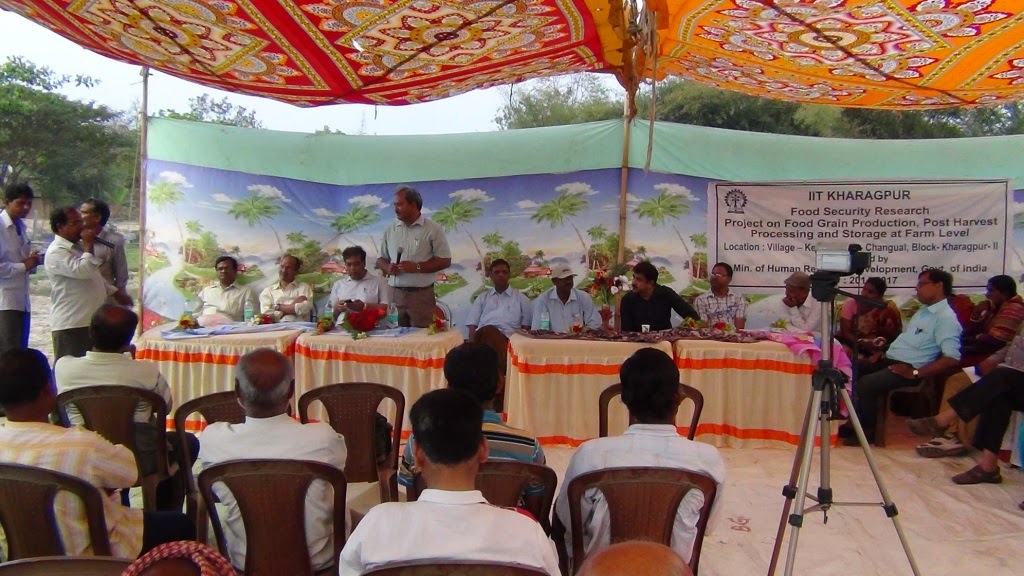
Indian Institute of Technology (IIT), Kharagpur has taken an initiative to demonstrate and increase awareness about existing technologies on food grain production and post-harvest processing at farmers field. With the support from Ministry of Human Resource Development, IIT Kharagpur has adopted 14 acres of land from 14 farmers in Kenthia village (Kharagpur Block–II, Paschim Medinipur), located within 10 km from the Institute campus.

A Field Day was organized on 25 March 2015 to develop awareness among the farmers of this village and neighboring villages on scientific food grain production. Dean, SRIC, Dean, Planning and Coordination, Project Coordinator,  Principal Investigator and Co-Principal Investigators of the project from IIT Kharagpur, Agricultural officers of West Bengal Govt., and Panchayat level official participated in the Field Day. Farmers had a very good opportunity to interact with scientists, officers and gain knowledge on the scientific production technologies. Agricultural officers and farmers from neighboring village want to have similar project in many locations that will help capacity building of farmers on scientific production technologies and hence production improvement. 

Presented below the salient features of the project and visuals from the field. Appended at the end videos of discussion held on the field day but in local language. It includes talks of farmers, Panchayet Pradhan, Development Officers of West Bengal Govt., Dean, SRIC, Dean P & C and IIT Kharagpur faculty associated with the project. Videos also pan on the surrounding by which activities in the project site can be seen.


The Challenge

With the shrinking and degrading land and water resources and changing climate, the implementation of the National Food Security Act forces to increase the food grain productivity by 50% in 2020 and 100% in 2040 to meet the demand. 
 
Objective

Demonstration of sustainable production and post-harvest processing technologies in farmers’ field to increase food grain productivity and economy of the farmers.


Technology Demonstration Site

Land area of 14 acres from 14 farmers in the Village ‘Kenthia (PO-Benapur, Block- Kharagpur, Dist-West Midnapur)’ was selected for the project activities. The land has not been cultivated for the past 5-7 years. The technology demonstration site is 10 km away from IIT Kharagpur .


Land Preparation

Small adjacent fields belonging to a single farmer were merged to make larger fields. Primary and secondary tillage was done by tractor driven plough followed by leveling during November 2014.

Ground Water Monitoring

Groundwater monitoring is essential for sustainable agriculture. Based on the  long term field data , improved management strategies will be formulated for efficient utilization of ground water.


Water saving rice production technology

-The production technology of System of Rice Intensification (SRI), which  saves 80-90% seed and 40-50% water requirement is demonstrated in the farmer’ field.

-Rice seedling of two weeks age were transplanted at one seedling per hill with 25cm × 25cm spacing in SRI, whereas seedlings of four weeks age were transplanted at three seedlings per hill with 20cm × 20cm spacing in conventional production system during the dry season of 2014-15.


Organic rice production

-Organic rice production technology is introduced for both SRI and conventional rice technology.

-Nutrients are supplied through commercially available organic manure and plant protections measures followed are mechanical weeding and use of bio-pesticides. 

Crop Diversification
Farmers had preference to grow rice crop only. However, considering the land topography, water demand, and soil fertility; we introduced high value and soil restoring crops such as sweet corn, sesame, soybean, and peanut. Sweet corn is an important vegetable cash crop consumed widely for its taste and nutritional benefits. It is rich in vitamins and minerals. Leguminous crops like soybean and peanut will add biological N and improve soil health for sustainable production, besides being rich source of protein and oil.


Vermicomposting
Cow dung , water hyacinth and farm wastes are used as inputs for the composting process with 2.5-3.0 kg earthworms (Eisenia foetida) in each bed of size 1.8m×1.2m×1m. Each bed is expected to produce 100kg of vermicompost in one cycle of 60 days. 
 
Pond structure for Integrated Farming

To increase economy of the poor farmers, pond of size 25mx15.5mx2m is renovated to store rain water and grow fish as component of integrated farming system. Pond was plastered with bentonite clay to check the water loss through seepage. The stored rain water will be used to provide life saving irrigation.
 

Future Activity

-Crop planning i.e. crops and cultivars selection with area allocation to maximize return per unit water, nutrient and other resource

-Demonstration of post-harvest processing and storage technologies of food grains at the farm level.

-Imparting training on organic farming, soil health, micro irrigation, etc to village youth to become entrepreneur.

Field Day (25-03-2015) videos (Playlist Link)